
WHAT WE DO
A pump station is a small plant room built in a hole in the ground. Every metre of pipe, every valve and every lifting point has to be right the first time.
IMEC designs primary and secondary pump stations for underground mines, from the hydraulic duty through to construction drawings and commissioning. Our stations are in service at gold, nickel, copper and zinc operations in Australia, Indonesia, the Philippines and Europe.
What goes into a station
A primary station lifts the mine’s water to surface, so it has to keep working as the mine deepens and inflows change. IMEC’s design process covers:
- Duty and hydraulics. Flow, head and water quality now and across the life-of-mine plan, from a hydraulic model of the whole network, not just the station. The Indonesian station on the 400 L/s Primary Pump Station page was sized to 400 L/s at over 200 m head to keep a lowered water table ahead of mining.
- Pumpsets and equipment. Pump, motor and valve selection matched to the duty and the water. Hot or dirty water narrows the field quickly: at 85 °C the Indonesian station needed specialist suppliers rather than standard catalogue equipment.
- Settling and filtration. Clean water in means reliable pumps. At OceanaGold’s Didipio mine the life-of-mine system uses filtration and settling on each level to deliver treated water to surface at over 500 L/s. Didipio Pump Station CPS2
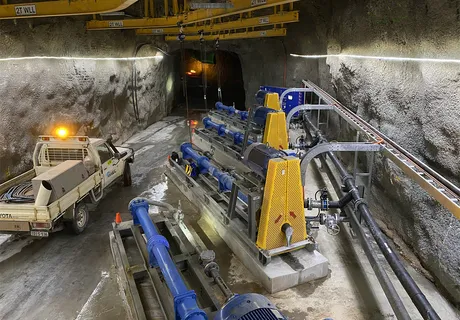
- Layout for maintenance. Monorail cranes over every pump, valve access that a person can actually reach, cable trays that do not block it. A recent station has 4 pumps, 80 m of monorails, 71 valves and over 200 m of steel pipework, plus switchroom and transformer chambers.
- Civil and structural. Concrete plinths and slabs, sump sizing and bogger access, suction and discharge piping supports, monorail steelwork. The Deflector pump station covered all of these plus the rising main to surface, with IMEC managing construction on site.
- Rising mains. Route, pipe class, anchoring and installation method for the delivery line to surface, including cable-lowering and pipe-installation systems where a borehole route is used.
Checked in virtual reality before it is built
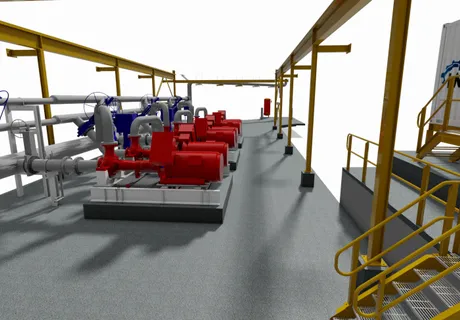
Every IMEC station is modelled in 3D and placed in real-world survey data. Before drawings are issued for construction, the client walks the station at 1:1 scale in virtual reality with our designers: checking clearances between equipment, valve access, serviceability, and how the station looks at each construction stage against the schedule. Comments are marked up in the model and land with the design team in real time. It finds constructability problems while they are still on paper. The process is described in VR Pump Station Design.
Deliverables
- Hydraulic model and duty selection
- P&ID, general arrangement and 3D model
- Mechanical equipment specifications: pumps, motors, valves, pipework, instruments
- Civil and structural design and drawings: plinths, slabs, sumps, monorails, supports
- Rising main design and installation methodology
- HAZOP and safety-in-design reviews
- Construction methodology, and construction management and commissioning support where wanted
Designs are produced under IMEC’s ISO 9001 certified quality management system.
Planning a new station, or nursing an old one? Get in touch.